- Reverse osmosis separates dissolved solids (limescale, salts, metals) from water by forcing it under pressure through a semi-permeable membrane.
- It needs pre-filtration: 5-micron sediment and activated carbon to remove chlorine, which damages the membrane.
- MEMBROM® membranes with FILMTEC™ sheet reject 97% of dissolved solids while sending only 66–75% of the water to drain.
What is reverse osmosis
In water purification, reverse osmosis is the separation of everything dissolved in the water, to obtain pure water with virtually nothing dissolved in it.
To achieve this, water is forced under pressure through a semi-permeable membrane sheet, with pores of a similar size to a water molecule. Impermeable means water cannot pass through a material; permeable means it can; and semi-permeable means part of it can pass through and part cannot.
- The pure water molecules that pass through the membrane form the product water or permeate.
- Molecules bound to dissolved components are larger than the pores, so they don’t pass and leave through another outlet: this is the waste water, also called concentrate or brine.
This is how dissolved solids such as calcium carbonate (limescale), salts and heavy metals are separated from the water. The process needs a minimum pressure to force the water through the membrane. For an overview, see what reverse osmosis is and how it works.
What a reverse osmosis membrane looks like
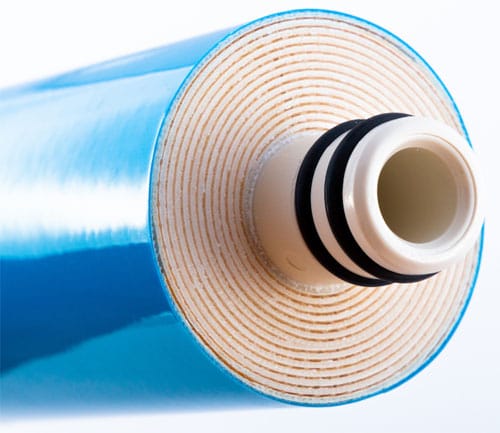
The membrane is cylindrical: the semi-permeable sheet is wound in a spiral around a polypropylene tube perforated along its length. Water enters at one end and travels through the spiral; the pure water molecules pass into the central tube, which carries them to the product water outlet, and the rest is carried to the other end as waste water.
The membrane housing
The membrane doesn’t work on its own: it needs a casing or membrane housing of the right size, with a water inlet at one end and two outlets at the other: a central one for product water and a side one for waste water.
- The screw cap usually has two O-rings that prevent leaks under pressure.
- Inside there is a recess into which the end of the membrane with two O-rings fits.
- The membrane also has a larger seal that forces the water to pass through it.
Membrane housings are usually made of polypropylene. As our membranes are almost always used for drinking water and last much longer than conventional ones, at MEMBROM® we sell an anti-bacterial membrane housing that prevents microbial growth.
The sheet: FILMTEC™ TFC
At MEMBROM® we use the most effective sheet: aromatic polyamide TFC (thin film composite), made by FILMTEC™, the world pioneer in reverse osmosis membranes.
- We chose a sheet that rejects less water (66–75%) and produces more (25–33%), while separating 97% of dissolved solids.
- It needs no preservative liquid: the membranes are delivered dry and can be stored sealed for years with virtually no expiry date.
- We also distribute the latest FILMTEC™ membrane models, which separate up to 98–99% of dissolved solids at very low pressure. The AQUALAST™ model handles water of up to 2,000 ppm.
Why reverse osmosis needs pre-filtration
The membrane is only designed to separate dissolved solids. Mains water, which is what we purify at MEMBROM®, contains two other components that must be removed first:
| Component | Technology | Filter |
|---|---|---|
| Suspended solids | Microfiltration | Sediment filter |
| Sodium hypochlorite (chlorine) | Adsorption | Activated carbon filter |
Removing sediment
All membranes need 5-micron nominal pre-filtration: smaller particles clog and damage the membrane and reduce its life and performance. For any brand, a minimum nominal filtration of 50% would be enough, but we have found that membranes last and perform much better with 82% filters.
Be careful: many filters sold as “5-micron” don’t even reach the 50% nominal rating the standard requires. MEMBROM® sediment filters retain 82% of 5-micron particles and 99% of 10-micron particles, and thanks to their patented internal structure they last 15 to 20 times longer than a conventional filter with the same retention.
Removing chlorine
Membranes are very sensitive to chlorine and other oxidants such as ozone. Chlorine opens up the pores of the sheet and lets contaminants into the product water, increasing its TDS and conductivity and reducing the membrane’s performance.
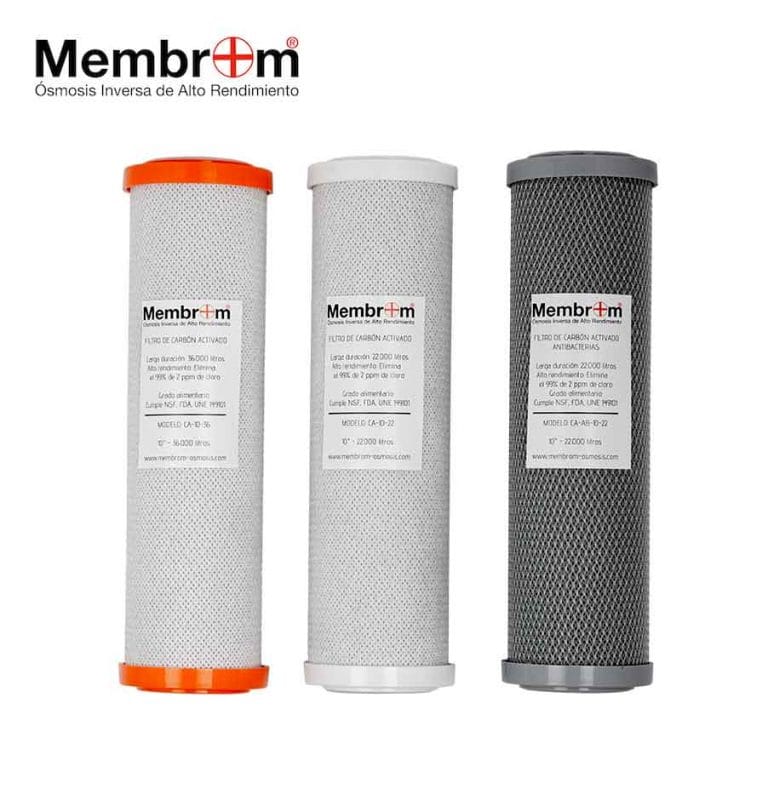
Although almost all membranes tolerate up to 0.1 ppm of chlorine, they will last much longer if none reaches them. Many conventional carbon filters don’t remove all the chlorine, have a short life and release carbon particles that the membrane then has to filter out. MEMBROM® filters with super-activated carbon guarantee complete chlorine removal, flush clean in just 5 minutes and last 22,000 to 56,000 litres. We explain it in activated carbon filters: adsorption and dechlorination.
Water production by reverse osmosis
Once the sediment and chlorine have been removed, the water reaches the membrane. The amount and quality of the water produced depend on:
- The membrane: composition, quality, separation capacity, output and product-to-waste ratio.
- Operating conditions: flow rate, pressure, temperature and the amount and composition of dissolved solids in the inlet water.
That’s why, for each MEMBROM® and FILMTEC™ membrane, we state the laboratory test conditions (dissolved solids, pressure, pH and temperature) and point out that each membrane can vary by up to 20% because of these factors. More details in how to work out the amount of water produced and rejected.
MEMBROM® systems and replacement parts
Most home systems with standard 50, 75 or 100 GPD membranes are designed to work in balance with compatible filters and membranes of the same size.
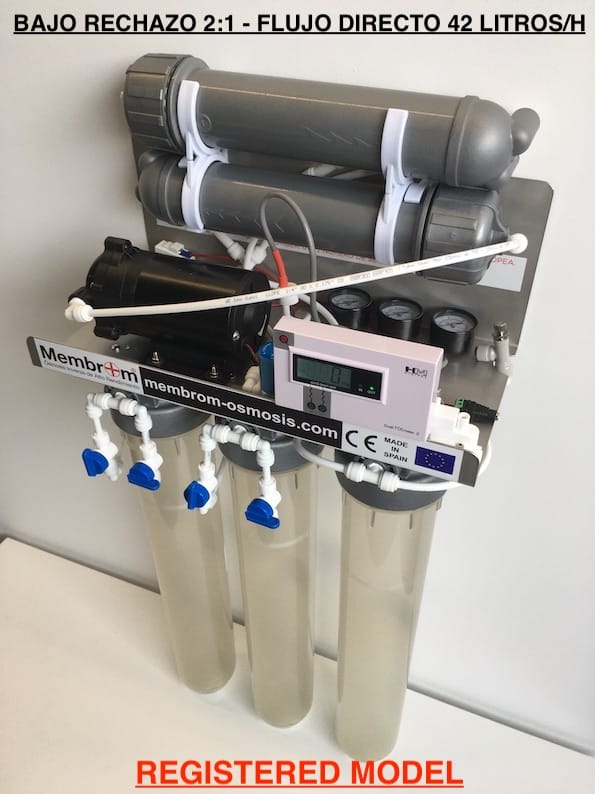
- We have designed low-waste reverse osmosis systems that produce very high-purity water with minimal waste and filters and membranes with an exceptional lifespan.
- We also offer them with monitoring, with flow meters and real-time and cumulative litre counters.
- If you already have a system, our filter and membrane packs include the best pre-filtration to extend the life of your membrane.