MEMBROM® deioniser and demineraliser filter

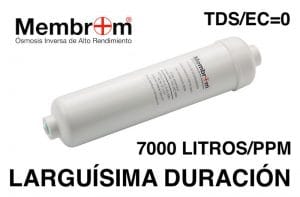
Mixed-bed ion exchange resin for ultrapure water with a TDS and EC of 0, purer even than distilled water. It is installed after the reverse osmosis system and treats 7,000 litres per ppm of dissolved solids.

0TDS or EC guaranteed in the water produced
7,000litres per ppm (mg/l) dissolved
12″ × 2.5″large inline size
1/4″quick-connect tube fittings
Mixed-bed resinSingle use: no channellingEU and US standardsType I, II and III laboratory waterFree 24/48h shipping to mainland Spain

Deionisation

Deioniser and demineralisation packs

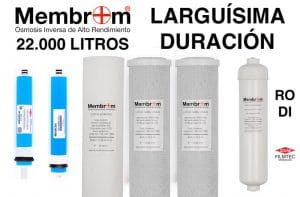
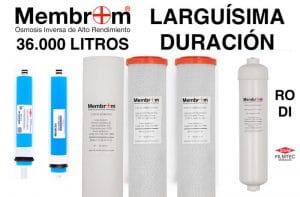
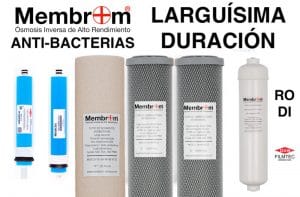
The deioniser filter on its own or in a pack with long-life filters and a membrane for your reverse osmosis system.

Lifespan

How many litres does the deioniser last?

The filter’s capacity is expressed in litres per ppm, so you know exactly when to change it.

A simple calculation

Litres = 7,000 ÷ ppm of the incoming water

The purer the incoming water, the longer the resin lasts. That’s why it is installed after the reverse osmosis system.

1,400 Lwith 5 ppm reverse osmosis water
700 Lwith 10 ppm reverse osmosis water
350 Lwith 20 ppm reverse osmosis water

Measure the water coming out of your reverse osmosis system with a TDS meter to work out the lifespan. When the deionised water no longer reads 0, it’s time to change the filter.

Applications

What is deionised water used for?

Laboratories

Ultrapure water for type I, type II and type III laboratory use.

Industrial process water

Processes that need water free of dissolved solids.

Pharmaceuticals and batteries

Pharmaceutical solutions and battery water.

Aquariums

Marine and tropical aquariums: removes phosphates, silicates and nitrates.

Why MEMBROM®

A single-use filter, for reliability

We chose single-use deioniser filters and improved their internal design to use 100% of the resin. This prevents channelling: small streams of water that bypass part of the resin and let some water out unpurified, a very common problem with refillable filters.

  • Full use of the ion exchange resin.
  • All the water that flows through comes out purified.
  • Precise lifespan: 7,000 litres per ppm (mg/l).
  • Materials approved in the EU and US for drinking water.
  • Large 12″ × 2.5″ inline size with 1/4″ quick-connect fittings.

How demineralised water is produced

  1. Sediment filters catch particles.
  2. Activated carbon removes chlorine.
  3. Reverse osmosis removes 90–99% of dissolved solids.
  4. The deioniser removes the rest, down to a TDS of 0.

Frequently asked questions

Common questions about the deioniser filter

What is a deioniser filter?

It is a filter with ion exchange resins that remove ions dissolved in the water, such as calcium, magnesium and sodium. The result is demineralised water with a TDS or EC of 0.

Why is it installed after the reverse osmosis system?

Because its lifespan depends on the dissolved solids in the incoming water: it treats 7,000 litres per ppm. With 10 ppm reverse osmosis water it lasts around 700 litres; with mains water at several hundred ppm it would be exhausted almost immediately.

Is deionised water purer than distilled water?

It can be. The MEMBROM® deioniser filter produces water with a TDS or EC of 0, purer even than distilled water.

How do I know when to change the filter?

With a TDS or conductivity meter: as long as the deionised water reads 0, the filter is still working. When the reading starts to rise, it's time to replace it.

Can it be refilled with new resin?

Our filter is single-use to make sure all the water passes through the resin. Refillable filters tend to develop channels through which unpurified water escapes.

Need demineralised water for your laboratory or aquarium?

We’ll help you choose the right combination of reverse osmosis and deioniser for the water in your area.