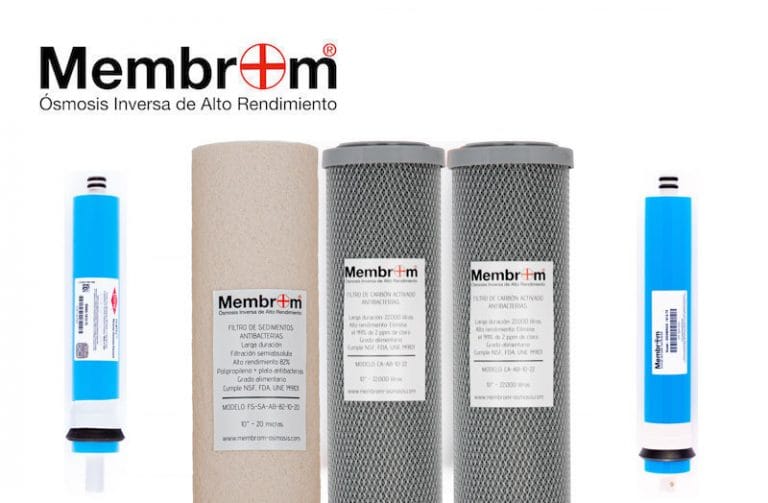
- Sediment filters remove suspended solids (TSS) by microfiltration, from 0.1 to 100 microns.
- Nominal filtration: retains 50 to 95% at the stated size. Absolute: at least 99%.
- MEMBROM® semi-absolute filters retain 82% at the nominal size and 99% at the next size up, and last up to 20 times longer than a standard filter.
Sediment filters are used to remove suspended solids from water. The right design depends on the amount of solids, their size and the degree of removal you want to achieve. In this guide we explain how they are measured, what types of filtration exist and how MEMBROM® filters differ.
1. What suspended solids (TSS) are
The total solids (TS) in water fall into two groups:
- Suspended solids (TSS, Total Suspended Solids): particles that float in the water without dissolving, such as sand, dust or mud. They are removed with sediment filters.
- Dissolved solids (TDS, Total Dissolved Solids): dissolved salts, limescale or metals. They are removed with reverse osmosis.
In this article we focus on suspended solids.
How TSS is measured
Specialist laboratories filter the water through specific filters, dry them and weigh the solids retained. The result is expressed in milligrams per litre (mg/l). By using filters with different pore sizes, they can also show what percentage of the sediment corresponds to each size. This is a real analysis we carried out for a customer:
| Particle size | % of sediment |
|---|---|
| 0 – 0.2 microns | 2% |
| 0.2 – 0.5 microns | 3% |
| 0.5 – 1 micron | 5% |
| 1 – 5 microns | 7% |
| 5 – 10 microns | 23% |
| 10 – 20 microns | 30% |
| 20 – 50 microns | 15% |
| Over 50 microns | 15% |
The problem is that these analyses are only done by specialist laboratories and are expensive, so they are out of reach for individuals or small businesses.
Do turbidity meters help?
Turbidity meters are affordable, but they don’t reliably measure suspended solids. They work by measuring how much light passes through the water, so they give an estimate without distinguishing particle size or whether the turbidity is due to other causes, such as dissolved or volatile substances. Only when you know the turbidity is mainly caused by suspended solids do their readings come close to reality.
As an alternative, at MEMBROM® we make microfiltration systems that, among other applications, can measure the percentage of suspended particles in the water fairly accurately. They are much cheaper than a laboratory analysis and a reliable tool for deciding which filters you need.
2. Microfiltration and sediment filters
Microfiltration is the technology that retains and separates suspended solids larger than 0.1 microns (a micron is a thousandth of a millimetre). It is carried out with sediment filters whose pores generally retain particles between 0.2 and 100 microns.
Standard filters are made for nominal filtration of 1, 5, 10, 20 or 50 microns, and for absolute filtration of 0.1, 0.2, 0.5, 1 or 3 microns.
| Filtration type | What it retains | Example |
|---|---|---|
| Nominal | On average, between 50% and 95% at the specified size | A 5-micron nominal filter retains at least 50% of 5-micron particles |
| Absolute | A minimum of 99% at the specified size (under the international standard) | A 3-micron absolute filter retains at least 99% of 3-micron particles |
Beware of advertising claims: you often read “removes all particles of 5 microns and larger”. That isn’t true: it’s impossible to remove 100% of particles. With our absolute filtration filters we have reached 99.9% (and 99.99% in the FAMH series).
3. Not all sediment filters are equal
At MEMBROM® we specialise in purification elements that meet three requirements: real high performance, exceptionally long life and complete safety of the materials in contact with drinking water. To achieve this, we have researched advanced materials and manufacturing methods.
3.1 High-performance sediment filters
Our range of MEMBROM® sediment filters includes four series:
| Series | Filtration | Recommended use |
|---|---|---|
| FS-SA-82 | Semi-absolute (82% – 99%) | Water inlets for homes, buildings and industry, wells, and pre-filtration for carbon, reverse osmosis, water softeners or deionisation |
| FS-SA-AB-82 | Semi-absolute (82% – 99%) anti-bacterial | The same applications, with a bacteriostatic effect |
| FS-FA-99.9 | 99.9% absolute | Precision applications in research, industry or laboratories |
| FS-FAMH-99.99 | 99.99% absolute | The most demanding applications |
What is semi-absolute filtration?
MEMBROM® semi-absolute filters retain 82% of particles at the specified size and 99% of those at the next size up. For example, the FS-SA-82-10-20 model (10″ and 20 microns) removes 82% of 20-micron particles (nominal filtration) and 99% of particles of 50 microns or more (absolute filtration).
What is anti-bacterial filtration?
Anti-bacterial filters have a bacteriostatic effect: they prevent bacteria from developing, growing and multiplying over time on the surface and inside the filter. They are not bactericidal, meaning they don’t kill bacteria already present in the water.
MEMBROM® anti-bacterial filters add nothing to the water: the anti-bacterial material is built into the filter and does not mix with the filtered water.
3.2 Exceptionally long-life filters
If standard filters were held to the same retention as MEMBROM® filters, the difference in lifespan would be enormous:
- Semi-absolute (82% – 99%): up to 20 times longer life.
- Semi-absolute anti-bacterial: up to 15 times longer.
- 99.9% absolute: up to 5 times longer.
The secret lies in their patented internal structure, which holds a large amount of sediment without significant pressure loss. For example, the MEMBROM® FS-SA-82-10-5 filter (10″ and 5 microns) holds up to 90 grams of particles before the pressure drops noticeably.
3.3 Complete food safety
MEMBROM® sediment filters meet and exceed demanding European and US regulations for materials in contact with food. They are made of 100% pure polypropylene, suitable for drinking water, mineral water, juices, soft drinks and other food-grade fluids. The anti-bacterial versions combine pure polypropylene with anti-bacterial silver approved for food use.
Where to install sediment filters
Sediment filters are the first stage of almost any purification system: they protect the activated carbon filters and the reverse osmosis membranes. They are installed in 10″ or 20″ filter housings. If you want to see how they fit into the whole, read water purification basics.