- A small beverage company needed very pure water, with anti-bacterial control and without fully demineralising it.
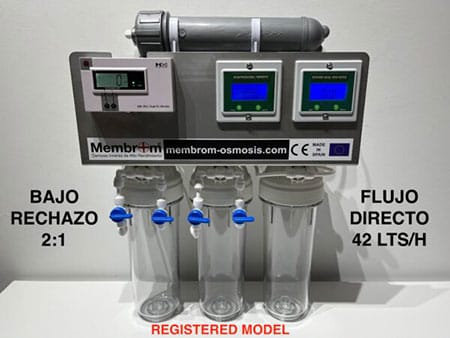
- The MEMBROM® OI-NX-2:1-07-AB20 semi-industrial reverse osmosis system brought the water down from 42 ppm to 3 ppm with no need for deionising resins.
- Savings: 385 litres of water a day and filters that last almost a year instead of a month.
MEMBROM® semi-industrial reverse osmosis stands out for how well it removes impurities, making it one of the preferred options for businesses and industries that need a constant supply of purified water. In this article we explain how it works and share a real case from the food industry.
Features of MEMBROM® semi-industrial reverse osmosis
- High-quality membranes: latest-generation semi-permeable membranes that remove everything from dissolved minerals to organic compounds.
- Optimised pressure: the system maintains the right pressure to maximise the separation of unwanted substances.
- High-retention pre-filtration: suspended particles, sediment and microorganisms are retained before the membrane.
- Monitoring and control: optional flow meters and water quality meters to adjust the system in real time if the inlet water changes.
- Energy efficiency: a design that minimises consumption without compromising water quality.
- Continuous treatment: designed to run 12 hours a day in alternating hours. By installing two systems in parallel, one supplies water for an hour while the other rests, ensuring a constant supply.
- Versatility: removes dissolved salts, organic matter and a wide range of common impurities.
- Easy maintenance: quick and accessible, to minimise downtime and extend membrane life.
What a 2:1 waste ratio means
A 2:1 ratio means that for every 2 litres of purified water, 1 litre is discarded carrying the concentrated impurities. The lower the waste, the less water is wasted. Its advantages:
- Efficient water use: more of the inlet water becomes purified water.
- Lower costs: less wasted water means lower water and discharge costs.
- Less pressure on water resources: a matter of environmental responsibility in areas with water shortages.
- Optimised process: the system is set up to balance purity and minimal waste.
- Suitable for critical applications: such as the pharmaceutical or food industries, where water must meet strict standards.
If you want to find out more, read high-performance 2:1 low-waste reverse osmosis.
Real case: a beverage company
“Is it possible to get very pure water with reverse osmosis alone?” That was the first question from this customer, a small beverage company looking for high-purity water with anti-bacterial control for food use.
The problem
- They started from very soft water, around 42 ppm, and none of the systems they had tried could bring the dissolved solids down to the level their drink required.
- They had to purify the water again with deionising resins, but the result was water with no minerals at all, which had a negative effect on the final product.
- They were constantly spending on consumables: sediment filters, activated carbon filters, membranes and resins.
- Their old system rejected 6 litres for every litre produced.
The solution
We installed a MEMBROM® OI-NX-2:1-07-AB20 semi-industrial reverse osmosis system, which managed to bring the water’s TDS down to 3 ppm with no need for deionisation.
How much water do they save?
The company needs 70 litres of purified water a day:
| Previous system (1:6) | MEMBROM® (2:1) | |
|---|---|---|
| Water produced per day | 70 litres | 70 litres |
| Water rejected per day | 420 litres | 35 litres |
| Savings | 385 litres of water a day | |
How much do they save on maintenance?
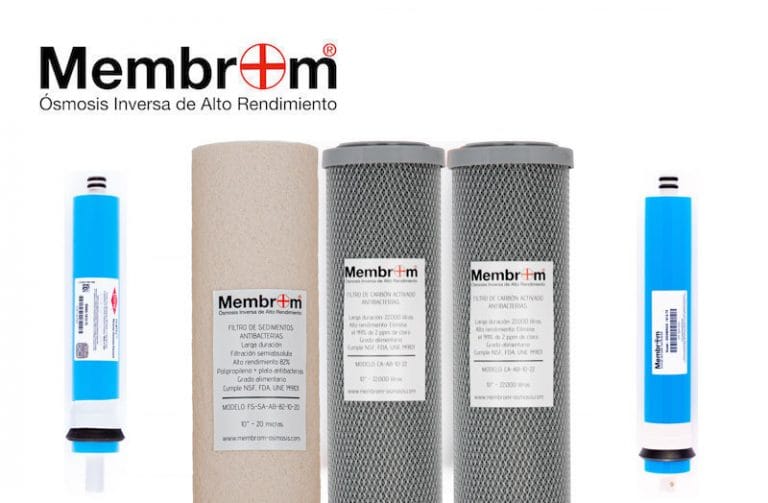
The system’s 20″ anti-bacterial filters last 36,000 litres. With 105 litres a day entering the system (70 produced + 35 rejected), the filters last 342 days, almost a year. Before, they had to change the filters at least once a month and the membranes every 3 months, so the savings in consumables and operator time are also significant.
What about hygiene control?
As this is a food business subject to bacteriological controls, we recommended the fully anti-bacterial AB20 model: it includes anti-bacterial filter housings and pre-filters, as well as the anti-bacterial membrane housings fitted as standard on all MEMBROM® systems. This makes bacterial growth inside the system or in the water produced virtually impossible.
As an additional safeguard, 10 metres from the system, right where the water is used to make the drink, a pharmaceutical-grade 0.2-micron absolute filtration post-filter was installed, which retains any bacteria that might accidentally appear in that section.
Semi-industrial and industrial systems
We have improved this model with optional flow meters in litres per minute and cumulative litre counters. You can see it, together with higher-output systems, in commercial and industrial reverse osmosis. For lower consumption, see the MEMBROM® 2:1 low-waste systems.
Discover more solutions for your sector in reverse osmosis for the food industry.