- Product water (permeate) is the water that comes out purified; waste water (concentrate) carries the dissolved solids to the drain.
- A standard membrane produces 15% and rejects 85% (a 1:6 ratio). MEMBROM® membranes reach 1:2 or even 1:1 while maintaining 96–97% purification.
- Water temperature can change output, waste and purity by up to 20%.
What product water and waste water are
Product water or permeate is the water that comes out of the reverse osmosis membrane purified.
Waste water or concentrate is the water that doesn’t pass through the membrane. It contains the dissolved solids separated from the product water plus those already in the water that wasn’t purified. In other words, it concentrates all the dissolved solids that entered the membrane and didn’t leave through the product line.
The amount of water produced relative to the water entering the membrane is expressed as a percentage, and to find it you need to check the manufacturer’s technical specifications.
Output and waste of a standard membrane
In most membrane specifications, achieving the usual 97% purification means a recovery of around 15%: of every 100 litres that go in, 15 become product water and 85 waste water. That’s an approximate ratio of 1:6 (product : waste).
The new 50 and 75 GPD FILMTEC™ models specify that, with that 15% recovery and 85% waste, they can reject up to 99% of dissolved solids.
How MEMBROM® membranes reduce waste
| Membrane | Product : waste | Dissolved solids removal |
|---|---|---|
| Standard membrane | 1:6 (15% : 85%) | 97% |
| MEMBROM® 50, 75 and 100 GPD | 1:3 (25% : 75%) | 97% |
| MEMBROM® 50, 75 and 100 GPD (later analyses) | 1:2 (33% : 67%) | 97% |
| MEMBROM® 200 GPD | 1:1,5 (40% : 60%) | 96% |
| MEMBROM® 200 GPD (tests with lower waste) | 1:1 (50% : 50%) | 96% |
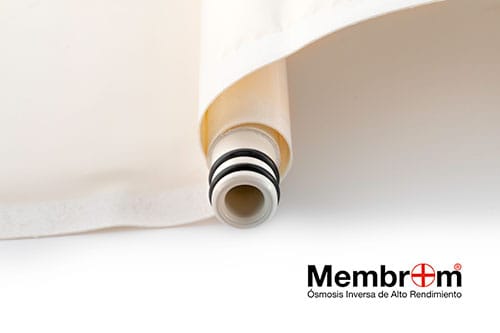
With MEMBROM® 50, 75 and 100 GPD membranes we guarantee a real 25% recovery and 75% waste while maintaining 97% removal of dissolved solids: a 1:3 ratio with a single membrane. Later analyses showed that their sheet can reduce waste to a 1:2 ratio without losing that 97%.
More recently we incorporated another sheet in the new MEMBROM® 200 GPD membrane. In the laboratory it removes 96% of dissolved solids with 40% recovery and 60% waste (1:1.5). When waste was reduced even further, the membrane maintained that 96% at a 1:1 ratio: of every 2 litres that go in, one is produced and one is rejected.
MEMBROM® low-waste systems
To get the most out of these sheets we have designed low-waste reverse osmosis systems with 2 or 4 membranes:
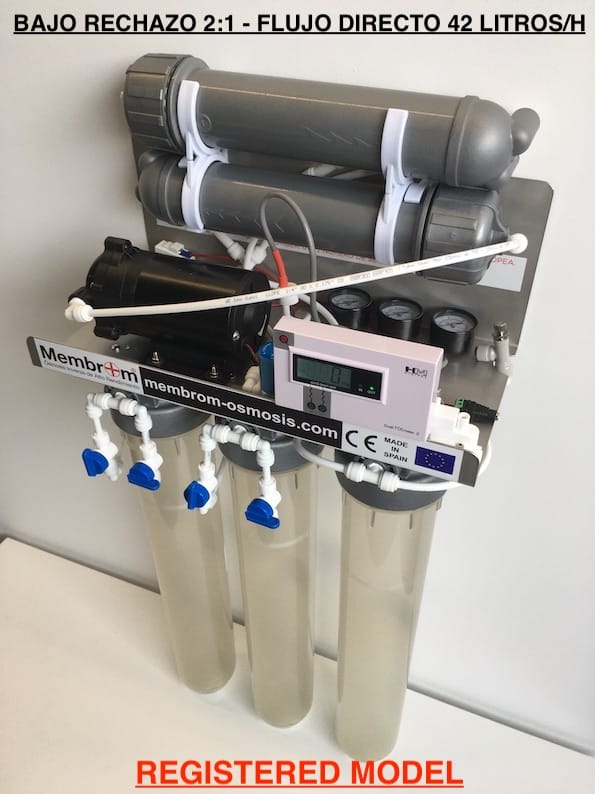
- 1:1 ratio with 2 MEMBROM® 75 GPD membranes: 30 litres per hour (of every 2 litres, 1 is produced and 1 is rejected).
- 2:1 ratio with 2 MEMBROM® 200 GPD membranes: 42 litres per hour (of every 3 litres, 2 are produced and only 1 is rejected).
- 2:1 ratio with 4 MEMBROM® 200 GPD membranes: 72 litres per hour.
Thanks to the high hydrophilicity of MEMBROM® membranes, these systems achieve high output with minimal waste and maintain a guaranteed purity of 95–99% in hard or very hard water and 90–95% in soft water, on both the 1:1 and 2:1 models. You can see it very clearly on the semi-professional systems with flow meters and water quality meters, the same as those used on industrial systems. We explain it in more detail in 2:1 low-waste reverse osmosis.
How much water does a reverse osmosis membrane produce?
Membrane output is expressed commercially in GPD (US gallons per day). For home use you’ll find 50, 70, 75, 80, 100, 125, 150 or 200 GPD membranes.
1 US gallon = 3.78541 litres. A 75 GPD membrane produces around 284 litres a day under laboratory conditions.
Membranes from 50 to 200 GPD are used in small systems for drinking and cooking, aquarium keeping (discus and tropical fish), growing (bonsai, orchids, hydroponics) or laboratories. At MEMBROM® we always give the equivalent in litres to avoid confusion.
The rated gallons are obtained in the laboratory under constant conditions. In practice, the amount and quality of product and waste water depend on many factors. The most important is the design of the system: watertightness, pre-filtration, hydraulic balance, flow restrictor size, etc. Pressure, hardness and water pH also play a part. That’s why the same membrane gives different results depending on the brand of system it is fitted in.
How does temperature affect a reverse osmosis membrane?
Once the membrane is installed, almost every factor is constant except one that changes continuously: the water temperature, which can alter the amount and quality of product and waste water by up to 20%.
| Water temperature | Product water | Waste water | Purity |
|---|---|---|---|
| Higher | More water | Less | Slightly lower |
| Lower | Less water | More | Slightly higher |
To measure the purity of your product water, see how to check the purity of the water produced by a membrane.