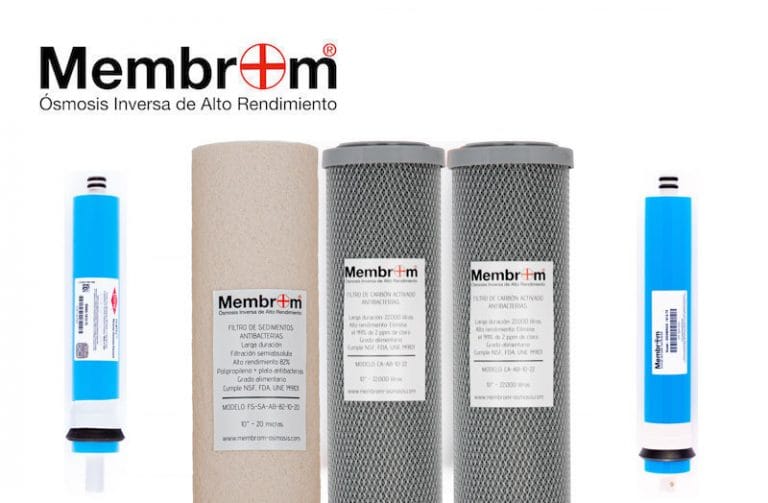
- A reverse osmosis membrane usually lasts 2 to 5 years, depending on its quality, the incoming water and maintenance.
- MEMBROM® and FILMTEC™ membranes last 50% to 300% longer than a standard membrane: up to 6 years when well maintained.
- The sign that it’s exhausted is that the purity of the water produced gets worse than usual.
It’s one of the questions we’re asked most: how often should the reverse osmosis membrane be changed? The short answer is that it depends, and in this article we explain what on, and how to tell when the time has come.
What does a membrane’s lifespan depend on?
The service life of a reverse osmosis membrane varies according to several factors:
- The quality of the membrane. A high-quality membrane lasts much longer than a standard one (we explain how to tell them apart in telling membrane quality apart).
- The incoming water. The more dissolved solids, sediment or chlorine it carries, the faster the membrane wears.
- Pre-filtration and maintenance. Good sediment filters and activated carbon filters protect the membrane from particles and chlorine.
- The system’s operating conditions (pressure, temperature, daily use).
How many years does a reverse osmosis membrane last?
In general, a reverse osmosis membrane lasts 2 to 5 years or more. This is an estimate, not a guarantee: a high-quality, well-maintained membrane such as a MEMBROM® or a FILMTEC™ can last up to 6 years, while a standard one may need replacing after 2 years.
Over time, contaminants and deposits build up on the membrane surface. This reduces the flow of product water and the effectiveness of dissolved solids removal, which is why it’s worth monitoring its performance regularly.
Lifespan in litres: standard membrane vs MEMBROM® or FILMTEC™
MEMBROM® and FILMTEC™ membranes last 50% to 300% longer than standard membranes. In litres of water produced, the difference is clear:
| Type of membrane | Approximate lifespan |
|---|---|
| Standard membrane | 3,650 litres of product water |
| MEMBROM® or FILMTEC™ membrane | 5,475 to 10,950 litres of product water |
How can you tell if the membrane is exhausted?
A membrane is exhausted when the purity of the water it produces is no longer what it has maintained during use. The easiest way to check is to measure the water with a TDS meter and compare it with your usual readings. We explain it step by step in how to check the purity of the water produced by a membrane.
When the time comes, follow our guide to installing a reverse osmosis membrane correctly.