- The purity of the water produced is measured by comparing the dissolved solids (TDS) or conductivity (EC) of the inlet water with that of the water leaving the membrane.
- A TDS meter gives the result in ppm (1 ppm = 1 mg/l). An EC meter gives it in µS/cm.
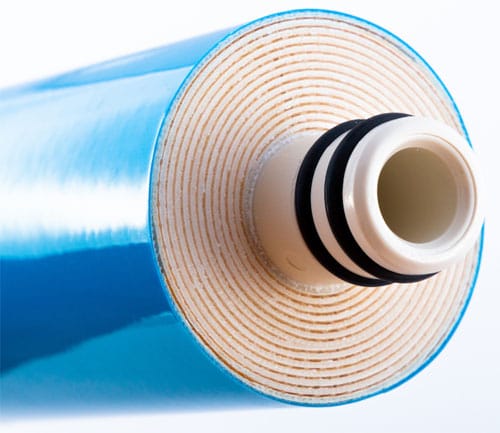
- MEMBROM® membranes remove a real 97% of dissolved solids, and the latest FILMTEC™ models between 98% and 99%.
How to calculate the purity of the water produced by a membrane
To find out how well a membrane separates dissolved solids, you need to compare the water you want to purify with the water the membrane produces. It’s very simple: just measure the dissolved solids or conductivity of the water going into the membrane and compare them with those of the product water.
The removal percentage is calculated as follows:
% removal = (inlet TDS − outlet TDS) ÷ inlet TDS × 100
Example: if the water goes in at 300 ppm and comes out at 9 ppm, the membrane removes 97% of the dissolved solids.
Results of MEMBROM® and FILMTEC™ membranes
If you compare our MEMBROM® reverse osmosis membranes with other brands, you’ll see that the purity of the water they produce far exceeds that of standard membranes. Only the latest advanced FILMTEC™ models do better, and we sell those too.
- MEMBROM® membranes: in our laboratory tests, a real 97% removal of dissolved solids.
- Latest FILMTEC™ membranes: between 98% and 99%, depending on the model.
How dissolved solids in water are measured
Dissolved solids are measured by weight. It’s the figure shown on mineral water bottle labels as “dry residue”: what remains of a litre of water after it has been evaporated. That residue is weighed, which is why it is expressed in mg/l (milligrams per litre).
TDS meters
To measure it without evaporating the water or weighing the residue, there are TDS meters, devices that are now very inexpensive and that anyone can use.
TDS stands for Total Dissolved Solids. The result is expressed in ppm (parts per million), which is exactly the same as mg/l:
1 ppm = 1 part per million = 1 milligram per kilo = 1 milligram per litre
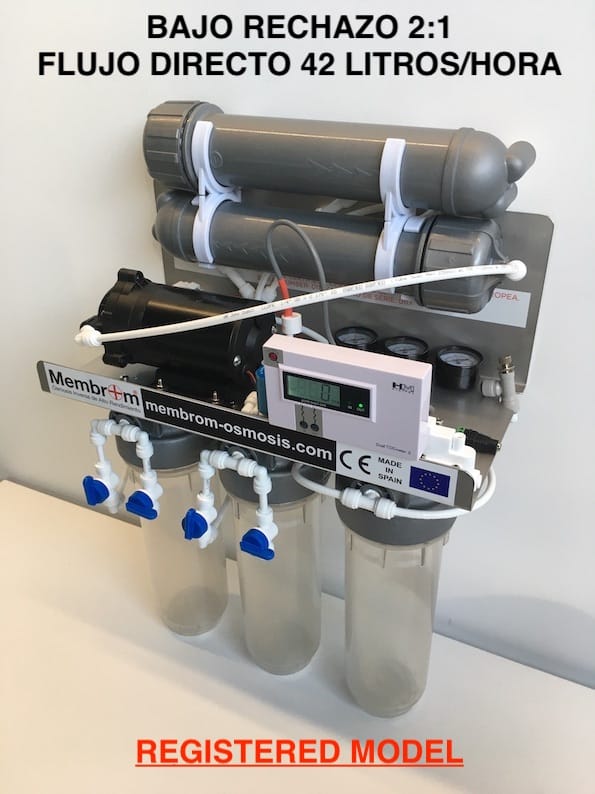
At MEMBROM® we make reverse osmosis systems with a built-in ppm TDS meter, so you can check the purity of your water at any time.
TDS reference values
| Water type | Approximate TDS |
|---|---|
| Seawater (Mediterranean) | 39,000 ppm (39 g/l of salt) |
| Seawater (Atlantic) | 37,000 ppm (37 g/l of salt) |
| WHO recommended limit for human consumption | under 500 ppm |
| Limit recommended by the European Union | under 300 ppm |
| Barcelona tap water (our latest reading) | 295 ppm |
| Málaga tap water (our latest reading) | 245 ppm |
| Typical mineral waters | 50 – 400 ppm |
| Madrid tap water (our latest reading) | 55 ppm |
| Low-mineral-content waters | under 50 ppm |
| Vigo tap water | 10 – 25 ppm |
| Purest mineral water in Europe (Italian Alps) | 14 ppm |
| Natural spring in Ponteareas (Pontevedra) | 7 ppm |
Electrical conductivity (EC) meters
TDS meters are actually conductivity meters: they measure the water’s ability to conduct electricity and convert that value into weight of dissolved solids using a formula.
Completely pure water does not conduct electricity; it’s the dissolved solids (minerals, salts and metals) that do. So by measuring conductivity we know how many dissolved solids the water contains.
Laboratories, aquariums and hydroponic growers usually measure conductivity rather than TDS. EC stands for Electrical Conductivity. All our commercial reverse osmosis systems can be fitted with a conductivity meter in microsiemens (µS).
Units and conversions
Conductivity is normally measured in µS/cm (microsiemens per centimetre). Although it isn’t always the case, the US drinking water standard, widely used around the world, sets this equivalence:
1 ppm = 2 µS/cm
Conductivity is sometimes expressed in mS/cm or S/cm:
1 S/cm = 1,000 mS/cm = 1,000,000 µS/cm
In some applications, electrical resistivity is measured instead of conductivity; it is the inverse and is expressed in ohm·cm (Ω·cm).
What to do if purity drops
If the purity of the product water gets worse than your usual readings, it’s a sign that the membrane is wearing out. We explain how long it usually lasts in how long a reverse osmosis membrane lasts and how to change it in how to install a reverse osmosis membrane.