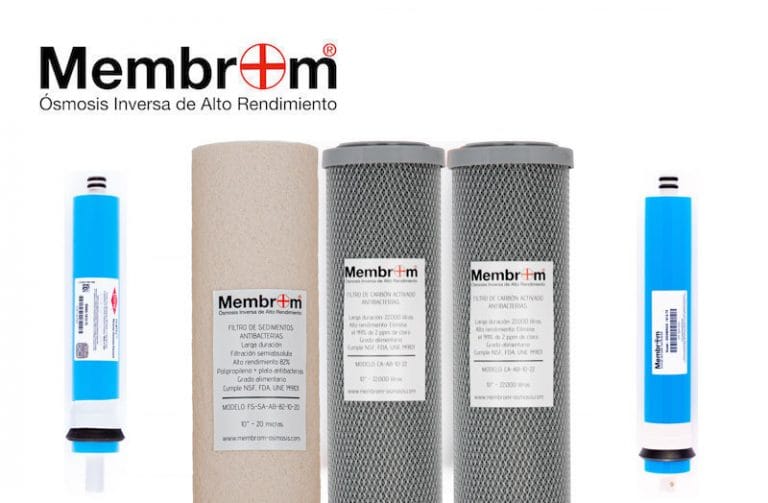
- Activated carbon removes volatile substances from water by adsorption: chlorine, ozone, volatile organic compounds (VOCs) and gases that cause odour and taste.
- Carbon block is more effective than granular carbon and releases far fewer particles.
- With 2 carbon filters in series, chlorine drops to 0.02 ppm after 22,000 litres: no taste and no risk to the reverse osmosis membrane.
What activated carbon removes
Activated carbon filters are used to remove volatile substances from water. Volatile substances are components that evaporate much faster than water, in other words, they turn into a gas far more easily.
The most common are chlorine, ozone, volatile organic compounds (VOCs) and other gases that cause odours and tastes, such as methane.
What is adsorption?
Adsorption (with a d, not to be confused with absorption) is the process by which activated carbon removes chlorine, odours and tastes. Carbon has microscopic pores, generally smaller than 2 nanometres, in which volatile substances stick and become trapped, separating them from the water.
Dechlorination: removing chlorine from water
Chlorine is the most common volatile substance in mains water and the main cause of its bad taste and smell. Dechlorination is the process that removes chlorine by adsorption, and dechlorinating filters are activated carbon filters designed for that purpose.
The raw material: coconut-shell carbon
There are many types of activated carbon. At MEMBROM® we have chosen the one with the highest adsorption capacity in the water industry, made from 100% processed coconut shell. As well as its performance, it recycles organic material that would otherwise be waste.
Granular carbon vs carbon block
| Granular carbon | MEMBROM® carbon block | |
|---|---|---|
| Water path | Enters at the bottom and leaves through the central opening at the top | Passes through the entire outer surface towards the centre: far more efficient adsorption |
| Carbon particles | Releases many, and you need to run off a lot of water to flush them out | Very few; with factory pre-washing and disinfection they are flushed out in about 5 minutes |
| Availability on the market | Most filters | Only a few manufacturers |
That’s why at MEMBROM® we decided to make only activated carbon block filters.
How to compare the quality of an activated carbon filter
There are three key factors:
- The carbon’s adsorption capacity: how much chlorine, taste, odour, colour and VOCs it can remove.
- Lifespan: the number of litres it works under optimum conditions without significantly losing capacity.
- Approved materials under European and US regulations for contact with food and drinking water.
The simplest and cheapest way to compare filters is to measure their chlorine removal capacity, because the removal of taste, odour and colour is directly proportional to their adsorption capacity. With a free chlorine meter you can easily measure the chlorine going into and coming out of the filter.
How to get the most out of MEMBROM® carbon filters
1. Always install a sediment pre-filter
MEMBROM® carbon filters have a nominal (50%) sediment filtration of 5 to 10 microns, depending on the model, but their capacity to hold sediment is low. If you use them on their own, they will last much less. We recommend fitting a sediment filter of at least 5 microns in front of them.
2. Use 2 carbon filters in series
Let’s look at a real example. Mains water in Spain usually contains at most 1 ppm of chlorine (our filters are designed for up to 2 ppm). The simplest model, the 10″ (around 25 cm) MEMBROM® CA-10-22, removes 99.99% of chlorine at the start and 85% at the end of its cycle, at 22,000 litres.
| Set-up | Chlorine at the outlet after 22,000 L | Result |
|---|---|---|
| Sediment + 1 carbon filter | 0.15 ppm (1 ppm − 85%) | Possible chlorine taste and above a membrane’s 0.1 ppm limit: change it at 15,000 L |
| Sediment + 2 carbon filters | 0.02 ppm (0.15 ppm − 85%) | No chlorine taste and no risk to the membrane, with room for many more litres |
With a single filter, at 15,000 litres it still removes 90% of the chlorine (0.1 ppm). That’s why, if you use just one, we recommend changing it at 15,000 litres. With two filters in series, the guaranteed minimum lifespan is 22,000 litres, which is the figure we give for our packs of 1 sediment filter and 2 activated carbon filters.
For the same reason, all our adsorption dechlorinators have one sediment filter and two activated carbon filters, to ensure thorough removal of chlorine and other volatile compounds.
If you’d like to know more about the previous stage, read sediment filters and microfiltration; and about the next one, reverse osmosis and dissolved solids.