Looking for a deioniser filter to get demineralised water, laboratory water or water with a TDS of 0? The answer depends mainly on one thing almost nobody checks before buying: whether the water in your area is soft or hard. With soft water, a good reverse osmosis system is usually enough for almost everything. With hard water, those same applications often need a deioniser added after the reverse osmosis system. In this guide we explain why, how to tell which case applies to you and how to set up the most efficient water treatment for your situation.
Quick summary
- A deioniser filter (DI mixed-bed resin) removes dissolved ions and can bring water down to a TDS of 0, but its resin is used up in proportion to the amount of salts it receives.
- On tap water it is exhausted within very few litres. With reverse osmosis in front of it, it lasts dozens of times longer.
- For most uses with soft water (aquariums, batteries, irons, window and solar panel cleaning, coffee machines, hospitality, process water) reverse osmosis water is already enough.
- But for the same applications with hard water, you will usually need to polish the reverse osmosis water with a deioniser, because reverse osmosis removes a percentage: the more salts that go into the system, the more salts come out in the purified water, and vice versa.
- And in every case, for type I laboratory water or ultrapure water, the right solution is commercial reverse osmosis + a final deionisation stage.
Contents
- Soft or hard water: why it changes everything
- What is a deioniser filter?
- Deionised, demineralised, distilled and reverse osmosis water: the differences
- Why reverse osmosis must come before deionisation
- Do you really need to deionise? Uses for soft and hard water
- How to treat the water step by step
- Which reverse osmosis system to choose
- Frequently asked questions
Soft or hard water: why it changes everything
Water hardness indicates its calcium and magnesium content, which make up most of the dissolved salts in mains water. In practice, the easiest thing is to measure the total dissolved solids (TDS) with a ppm meter. As a guide, soft water is water with less than 150 ppm, common in Galicia, Asturias, Cantabria or the city of Madrid. Hard water is water above 300 ppm, common in the Valencia region, Murcia, Catalonia, the Balearic Islands or eastern Andalusia. Water can vary a great deal within the same province, so measure your water before deciding.
Why does it matter so much? Because the reverse osmosis membrane removes a percentage of the salts it receives, around 95–99%, not a fixed amount. The purified water always keeps a small part of what the source water contained:
| Inlet water | Inlet TDS | TDS after reverse osmosis (≈ 97% rejection) |
|---|---|---|
| Very soft | 50 ppm | ≈ 1.5 ppm |
| Soft | 150 ppm | ≈ 4.5 ppm |
| Hard | 400 ppm | ≈ 12 ppm |
| Very hard | 700 ppm | ≈ 21 ppm |
Real results from MEMBROM® systems in different parts of Spain confirm it: from 42 ppm to 3 ppm in Pontevedra, from 305 ppm to 4 ppm in Granada and from 720 ppm to 20 ppm in Alicante. You can see the full table on our commercial reverse osmosis page.
That’s why with soft water, reverse osmosis brings the water down to very few ppm and is usually enough. With hard water, on the other hand, reverse osmosis water keeps enough salts for many applications to need a final polish. That’s where the deioniser filter comes in.
What is a deioniser filter?
A deioniser filter (also called a demineraliser filter or DI cartridge) is a cartridge filled with ion exchange resins. These resins capture the ions dissolved in the water — calcium, magnesium, sodium, chlorides, sulphates, nitrates, silicates, phosphates — and replace them with H+ and OH− ions, which combine to form water.
Mixed-bed cartridges combine cation and anion resin in the same filter, so they remove both types of ion in a single pass. The result is water with virtually zero conductivity (an EC or TDS of 0), known as deionised or demineralised water.
The key point is that the resin has a limited capacity: every gram of salt it retains uses up part of it. That’s why manufacturers express its lifespan in litres·ppm: a 7,000 litre·ppm cartridge, for example, treats 7,000 litres if the inlet water has 1 ppm, but only 70 litres if it has 100 ppm.
Deionised, demineralised, distilled and reverse osmosis water: the differences
The terms are used almost as synonyms, but they are not the same:
| Water type | How it is produced | What it removes | Cost per litre |
|---|---|---|---|
| Reverse osmosis water (permeate) | Semi-permeable membrane under pressure | 95–99% of dissolved salts, plus bacteria, viruses, organic matter and heavy metals; chlorine with the pre-filters | Very low |
| Deionised / demineralised | Ion exchange resins | Virtually 100% of ions. It does not remove bacteria or non-ionic organic matter | High if the inlet water has a lot of salts |
| Distilled | Evaporation and condensation | Salts and most non-volatile contaminants | High (a lot of energy) |
| Ultrapure (type I) | Reverse osmosis + polishing deionisation (and other stages depending on the application) | All of the above combined | Moderate if reverse osmosis is used first |
Reverse osmosis and deionisation don’t compete: they complement each other. The membrane does the heavy lifting (and removes contaminants the resin doesn’t touch) and the resin provides the final finish when the source water or the application requires it.
Why reverse osmosis must come before deionisation
It’s the most common mistake: connecting a deioniser filter straight to the tap. Let’s look at real figures with a 7,000 litre·ppm cartridge:
| Water entering the deioniser | Inlet TDS | Litres of deionised water per cartridge |
|---|---|---|
| Hard tap water | 400 ppm | ≈ 17 litres |
| Soft tap water | 100 ppm | ≈ 70 litres |
| Reverse osmosis with hard source water | 20 ppm | ≈ 350 litres |
| Reverse osmosis with soft source water | 3 ppm | ≈ 2,300 litres |
With soft water, reverse osmosis usually leaves the water so low in salts that you often don’t even need the deioniser, and if you do, the resin lasts a very long time. With hard water the deioniser is more necessary, and that’s exactly why it’s more important than ever to put reverse osmosis in front of it: without it, a cartridge that treats around 350 litres would only manage about 17. In addition:
- The membrane retains bacteria and organic matter, which the resin doesn’t remove and which can even colonise it.
- Chlorine in mains water degrades the resins; the reverse osmosis system’s activated carbon pre-filters remove it first.
- Sediment clogs the resin bed and creates channels through which water passes untreated; the sediment filter prevents this.
Do you really need to deionise? Uses for soft and hard water
Many people look for “deionised water” when what they really need is simply water with very few salts. If you know what quality your application requires and how many ppm your source water has, the decision is easy. Here is a guide:
| Application | With soft source water | With hard source water |
|---|---|---|
| Cleaning windows and solar panels with a water-fed pole | Reverse osmosis is enough | Reverse osmosis + deioniser recommended for a spot-free finish |
| Battery water (lead-acid, forklifts, solar systems) | Reverse osmosis is enough | Reverse osmosis + deioniser recommended |
| Irons, ironing stations and steam generators | Reverse osmosis is enough | Reverse osmosis + deioniser recommended in professional steam equipment |
| Humidifiers and misting systems | Reverse osmosis is enough | Reverse osmosis + deioniser recommended to avoid white dust |
| Industrial process water and parts rinsing | Reverse osmosis is enough | Reverse osmosis + deioniser when the final rinse must leave no residue |
| Type III laboratory water (washing glassware, autoclaves) | Reverse osmosis is enough | Reverse osmosis + deioniser if the required conductivity is not reached |
| Freshwater aquariums | Reverse osmosis is enough | Reverse osmosis is enough in most cases |
| Marine and reef aquariums | Reverse osmosis is enough in many cases; deioniser if there are silicates or phosphates | Reverse osmosis + deioniser |
| Hydroponic growing | Reverse osmosis is enough | Reverse osmosis is enough (nutrients are added afterwards) |
| Coffee machines, combi ovens and hospitality | Reverse osmosis is enough | Reverse osmosis is enough; 0 ppm water is not desirable here |
| Type II and type I laboratory water, pharmaceuticals, ultrapure water | Always reverse osmosis + final deionisation | |
There are two exceptions: for coffee machines and hydroponics you don’t want water with no salts at all. In coffee, fully demineralised water tastes worse and can be aggressive towards the machine’s metals; in hydroponics, the crop is fed with whatever is added afterwards. At the other end of the scale are type II and type I laboratories (reagents, analysis, chromatography or sensitive techniques), pharmaceuticals and industrial processes such as electronics, coatings or high-pressure boilers. There, the source water makes no difference: final deionisation is always needed. Type I ultrapure water reaches a resistivity of 18.2 MΩ·cm.
If you’re unsure what quality your application needs, get in touch with your water’s ppm and we’ll recommend the right set-up.
How to treat the water step by step
A well-designed water treatment system follows this order:
- Sediment pre-filtration. Retains sand, rust and particles that would damage the following stages. See sediment filters.
- Activated carbon. Removes chlorine, chloramines, odours, tastes and organic matter. Essential to protect the membrane and the resin. See activated carbon filters.
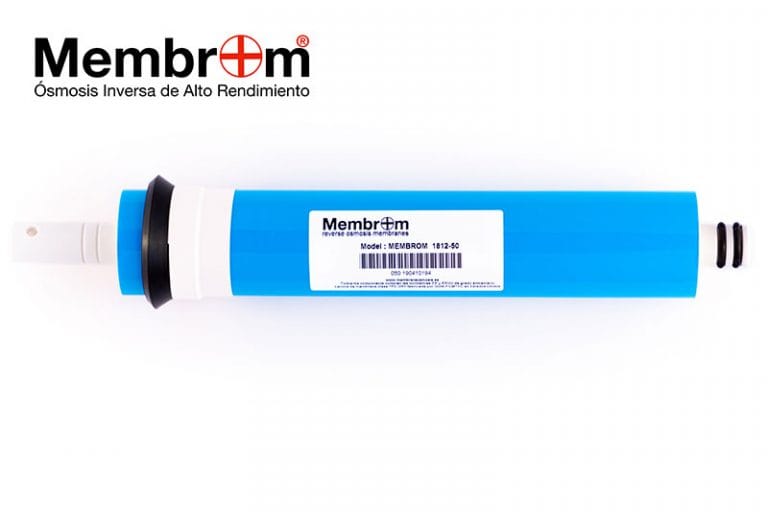
- Reverse osmosis. The reverse osmosis membrane removes 95–99% of dissolved salts, plus bacteria, viruses and heavy metals.
- Final polishing with a deioniser (depending on your water and your application). With soft water it’s usually optional; with hard water it’s necessary in most applications that require very few ppm; for type I laboratory water and ultrapure water, always.
One important detail: always measure the water. A TDS (ppm) or EC conductivity (µS/cm) meter at the inlet, after the reverse osmosis system and after the deioniser tells you whether you need to polish, when to change filters and the membrane, and when the resin is exhausted. As a reference, 1 µS/cm is roughly equivalent to 0.5–0.7 ppm. MEMBROM® commercial systems can be fitted with a TDS/EC meter and flow meters with counters to track the litres produced and the real lifespan of each filter.
Which reverse osmosis system to choose
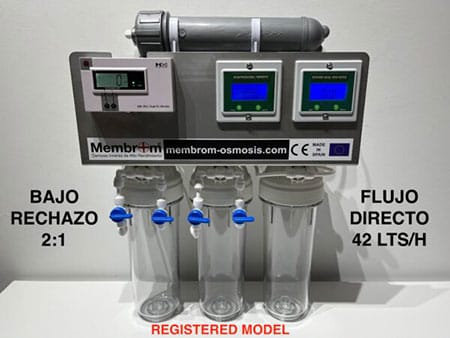
Whether your water is soft or hard, the basis of the installation is the same: a good reverse osmosis system. MEMBROM® commercial reverse osmosis systems are direct-flow and low-waste: they purify 1 in every 2 litres (1:1 models) or 2 in every 3 litres (2:1 models), compared with the 3–4 litres many home systems send down the drain for every litre produced. They are designed and made in Spain, with a 3-year warranty and exceptionally long-life filters (22,000, 36,000 or 56,000 litres).
| Requirement | Minimum output | Recommended system |
|---|---|---|
| Small laboratory, aquarium, moderate consumption | 30 l/h (0.5 l/min) | OI-PR 1:1-05 (AR10) |
| Daily professional use, minimal sanitary maintenance | 42 l/h (0.7 l/min) | OI-PR 2:1-07 anti-bacterial (AB10) |
| Hospitality, process water, professional cleaning | 72 l/h (1.2 l/min) | OI-PR 2:1-12 anti-bacterial (AB10) |
| High consumption, industry, multiple points of use | 102 l/h (1.7 l/min) | 1200 GPD 2:1-17 reverse osmosis |
The anti-bacterial (AB) models include anti-bacterial filters and filter housings and need no periodic disinfection, which is especially useful in laboratories and in applications where the water must stay microbiologically clean. The shatterproof (AR) models are designed for installations with high mains pressure.
If you’d prefer a more compact system or one for home use, see our range of low-waste reverse osmosis too. And for maintenance, you’ll find all the replacement parts in our filter and membrane packs.
Need demineralised or ultrapure water for your business or laboratory?
Tell us about your application, your daily consumption and the ppm of your mains water, and we’ll tell you whether reverse osmosis is enough or you need to add deionisation, with the most efficient set-up for your case.
Frequently asked questions about deioniser filters and demineralised water
What is the difference between a deioniser filter and reverse osmosis?
The deioniser filter uses ion exchange resins that capture dissolved ions until they are exhausted. Reverse osmosis uses a membrane that continuously separates a percentage of the salts from the water, without being used up with every litre, and also retains bacteria, viruses and organic matter. The most efficient approach is to use reverse osmosis as the main stage and deionisation as the finish when the source water is hard or the application requires a TDS of 0.
If my water is soft, do I need a deioniser?
In most cases, no. With soft water, a good reverse osmosis system normally brings the water down to between 1 and 5 ppm, which is enough for batteries, irons, aquariums, window and solar panel cleaning, humidifiers or type III laboratory water. You’ll only need it for type II and type I laboratory water, ultrapure water or very specific applications.
And if my water is hard?
Reverse osmosis will still remove the vast majority of the salts, but the purified water may end up at 10–20 ppm or more. For applications that require very few salts (window and solar panel cleaning, batteries, steam generators, reef aquariums, laboratories) the usual approach is to add a mixed-bed deioniser after the reverse osmosis system.
Is reverse osmosis water demineralised water?
It is water with a very low salt content, which depends on the source water: usually between 1 and 5 ppm with soft water and between 10 and 20 ppm with hard water. For most uses it works as demineralised water. To reach 0 ppm consistently, a deionisation stage is added at the outlet.
Can I use reverse osmosis water instead of distilled water?
Yes, in the vast majority of applications, especially if your source water is soft. With hard water, it’s worth polishing it with a deioniser for demanding applications. Either way, it’s far cheaper to produce than distilled water and you don’t need to buy it in bottles.
How long does a deioniser filter last?
It depends on the dissolved solids in the water it receives. A 7,000 litre·ppm cartridge lasts around 17 litres on 400 ppm tap water, around 350 litres on 20 ppm reverse osmosis water (hard source water) and around 2,300 litres on 3 ppm reverse osmosis water (soft source water). That’s why connecting it directly to the mains is never recommended.
What water do I need for a laboratory?
For washing glassware and general uses (type III), reverse osmosis is usually enough if the source water is soft; with hard water you may need a deioniser to reach the required conductivity. For reagents and analysis (type II) or very sensitive techniques (type I, 18.2 MΩ·cm) you always need reverse osmosis followed by deionisation. A commercial reverse osmosis system is the basis of any of these installations.
How do I know when to change the filters?
By measuring. A TDS or conductivity meter shows whether the water quality is getting worse, and a litre counter tells you how much each filter has produced. MEMBROM® commercial systems can include both.
See also: MEMBROM® deioniser filters, purified water for laboratory and medical use and reverse osmosis for aquariums.