
- Guide · Reverse osmosis
Reverse osmosis: what it is, how it works and what it needs
Reverse osmosis removes almost everything dissolved in water (limescale, salts and heavy metals) by forcing it under pressure through a semi-permeable membrane. We explain how it works and which systems, membranes and filters we manufacture at MEMBROM®.
How it works
The reverse osmosis process, step by step
Mains water passes through a pre-filtration stage that prepares it, then through the membrane, which splits it in two: product water and waste water.
What it is
What is reverse osmosis?
In water purification, reverse osmosis is the separation of everything dissolved in the water: the result is pure water with (almost) nothing dissolved in it.
To achieve this, water is forced under pressure through a semi-permeable membrane sheet with pores roughly the size of a pure water molecule.
- Product water (permeate): the pure water molecules that manage to pass through the membrane.
- Waste water (concentrate): the molecules bound to other dissolved substances, too large to pass, which leave through a separate outlet.
This is how dissolved solids such as calcium carbonate (limescale), salts and heavy metals are removed from the water.
In a nutshell
- What it does
- Removes dissolved solids
- How
- Pressurised water through a membrane
- Removes
- Limescale, salts, nitrates and heavy metals
- Needs
- Sediment and carbon pre-filtration
- Produces
- Pure water and waste water
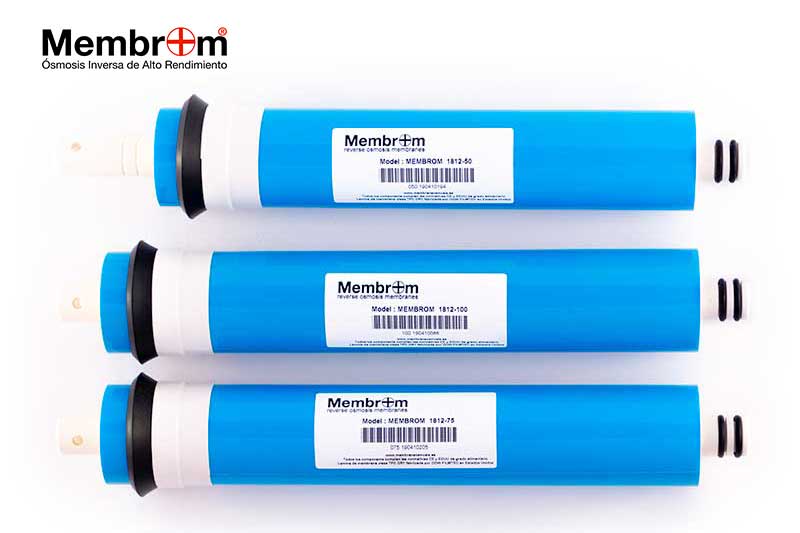
Membranes
What a reverse osmosis membrane looks like
Membranes use a semi-permeable sheet wound in a spiral around a central polypropylene tube perforated along its length.
Water enters at one end and travels through the spiral: the pure water molecules pass into the central tube, which carries them to the product water outlet. Those that cannot pass, because they are larger, are carried to the other end as waste water.
The membrane does not work on its own: it needs a housing with a water inlet at one end and two outlets at the other, one for product water and one for waste water.
Pre-filtration
Why does reverse osmosis need pre-filtration?
Mains water contains other substances that must be removed before they reach the membrane.
Suspended solids
The membrane is only designed to separate dissolved solids. Particles are trapped beforehand by sediment filters (microfiltration).
Chlorine
The sodium hypochlorite in mains water degrades the membrane. It is removed beforehand by activated carbon filters (adsorption).
Low waste
A conventional reverse osmosis unit sends several litres to drain for every litre purified. Our 2:1 systems purify 2 litres for every litre of waste.
Direct flow
Our systems purify on demand, with no storage tank, and deliver the water straight to the tap.
What it removes
What does reverse osmosis remove?
The membrane removes 90–99% of dissolved solids, while the pre-filtration removes chlorine and volatile compounds.
Our range
MEMBROM® reverse osmosis systems and replacement parts
Low-waste reverse osmosis
2:1 and 1:1 direct-flow systems.
Commercial reverse osmosis
With flow meters, stainless steel and an anti-bacterial version.
Reverse osmosis membranes
FILMTEC™ and MEMBROM® from 50 to 600 GPD.
Filter + membrane packs
A complete replacement set in a single order.
Sediment filters
They trap particles and protect the carbon filters and membranes.
Activated carbon filters
They remove 99% of chlorine, taste and odour.
Frequently asked questions
Reverse osmosis FAQs
What is reverse osmosis?
A process that forces water under pressure through a semi-permeable membrane to separate the dissolved solids. It produces pure water (product water or permeate) and water that carries away the separated substances (waste water).
What does reverse osmosis remove?
The membrane removes 90–99% of dissolved solids: limescale, salts, nitrates, sulphates, fluorides, arsenic, lead and other heavy metals. With carbon pre-filtration, chlorine, trihalomethanes and volatile compounds are also removed.
What is waste water?
It is the water that does not pass through the membrane and carries the separated dissolved solids to the drain. MEMBROM® low-waste systems send very little to drain: 1 litre for every 2 purified on the 2:1 models.
Why does it need filters before the membrane?
Because the membrane only separates dissolved solids. Suspended particles would clog it and chlorine would damage it, so sediment and activated carbon filters are fitted upstream.
What maintenance does a reverse osmosis system need?
Replace the sediment and carbon filters when they reach their capacity (22,000 to 56,000 litres on MEMBROM® filters) and the membrane when its performance drops, which with good pre-filtration can take years.
Does it need a tank?
Conventional reverse osmosis units do, but MEMBROM® direct-flow systems purify on demand and need no storage tank.
Thinking of installing reverse osmosis?
Tell us the ppm of your water and your daily consumption, and we will recommend the right system.